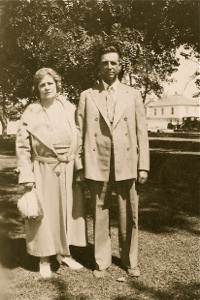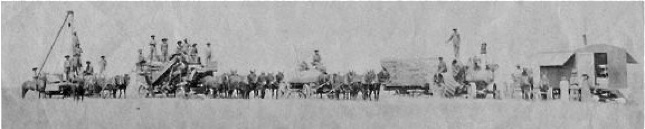














Wheat harvest, 1907. Scott Collin’s great-grandfather moved to the Five Corners area in covered wagons that year and homesteaded the original family home. The family well was originally drilled in 1907. The well has been in operation since that time. (Scott Collin family archive)

The New York Times
Industrial farms could leave eastern Wash. with dry wells
By Scott Streater, Greenwire
April 9, 2009
Scott Collins' family has been farming in arid eastern Washington since his great grandfather first homesteaded the 1,500-acre, dry-land wheat farm more than a century ago.
But the 58-year-old Collins fears he may be the last of four generations on the farm.
That is because the groundwater he and his family depend on could be in jeopardy if a proposed cattle feedlot and other industrial-sized projects like it are built in his rural Franklin County. . . .
Washington State promotes
mining water from ancient aquifers
-- disregards lessons of the past and 5,000 gallons per day limit on family wells --
State creates loophole giving unlimited water to factory farms
In 1946, one year after the Legislature enacted the groundwater code, the Department of Conservation published an overview of the groundwater code, which described the groundwater exemption statute as:
INDIVIDUAL DOMESTIC SUPPLY EXEMPT. The Ground Water Code exempts from administrative control the withdrawal of public ground water for any purpose where the quantity is less than 5,000 gallons per day. This exemption was provided to relieve the small water user of the formalities and costs of obtaining water for his household and domestic needs. Five thousand gallons per day will supply ample water for household use for a family, their garden and lawn irrigation, and stock water. The Department of Conservation interpreted the statute as limiting all exempt uses, including stock-watering, to 5000 gpd.
The agency believed the statute's purpose was to supply “small water users” with water, and the agency considered 5000 gpd an “ample” amount for such users. The Department of Conservation's interpretation limiting all exempt uses to 5000 gpd was consistent with the Bureau of Reclamation's estimation that maximum water use for small family farms would not exceed 1500 gpd.
for more on the legislative history behind Washington’s permit exempt wells and to read CELP’s comments to the County Water Board, click here.


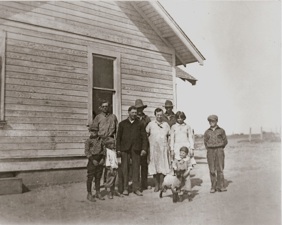
Charles and Jenny Jones family photo on their homestead, 1928. (Jones family archive)
On June 30, 2009, Five Corners Family Farmers joined the Center for Environmental Law & Policy (CELP) and Sierra Club in filing a lawsuit challenging the 2005 Attorney General Opinion that purports to authorize unlimited use of water for livestock purposes, including large dairies and feedlots. Family farmers and allies are represented by Janette Brimmer and Kristen Boyles, attorneys with Earthjustice’s Seattle office.
The Five Corners Family Farmers are a group of dryland wheat farmers whose families have been living and farming in the area since the early 1900s. Franklin County, Washington is one of the driest counties in the state and the Family Farmers group uses conservative farming practices in order to produce wheat without irrigation. The new industrial feedlot, Easterday Ranches, Incorporated, is pumping large quantities of groundwater from an area otherwise closed to new groundwater withdrawals due to decreasing aquifer levels. The Family Farmers worry that their wells, the source of all their water for drinking and household uses, will be threatened by this huge new, unregulated, industrial use.
Washington State's groundwater laws require a permit for groundwater use to protect people like the Family Farmers who already have wells and to protect streams and salmon habitat that are connected to or replenished by groundwater. For 60 years, the state allowed only a limited exception to the permit requirement for certain rural homestead uses.
In 2005, Attorney General Rob McKenna, in response to an inquiry from rural state legislators, issued an opinion that feedlots could use unlimited amounts of groundwater for watering their stock with no permitting required.
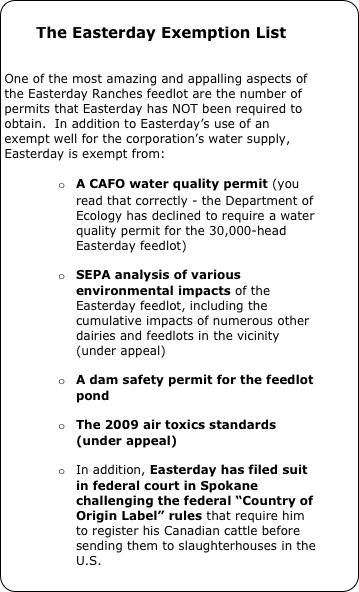
The state abruptly reversed its long-standing position and now claims it is unable to regulate groundwater used by feedlot operations like Easterday's for "stockwatering" no matter how large or industrialized the use is. The state will now allow the Easterday Ranches, Incorporated operation to pump up to 600,000 of its total 1,000,000 gallons a day in one of the driest counties of the state, without regulation and without protection for neighboring wells and springs. That is more than 1,000 times the amount of water an average eastern Washington household uses.
On June 16, 2011, Earthjustice asked the Washington State Supreme Court to strike down the Attorney General's interpretation of the groundwater requirements and to impose regulation on how much water can be used for livestock, including permitting requirements for large industrial feedlot operations.







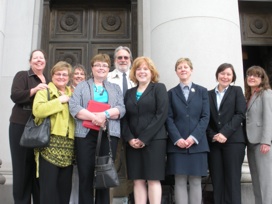
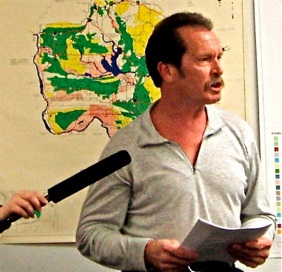
Scott Collins, Sheila Poe, Randy Jones, Pat Kenney. On the steps of the Supreme Court: Earthjustice, Five Corners Family Farmers, Center for Environmental Law & Policy, Sierra Club, tribal attorneys, and Aqua Permanente.
Randy Jones, Five Corners Family Farmers
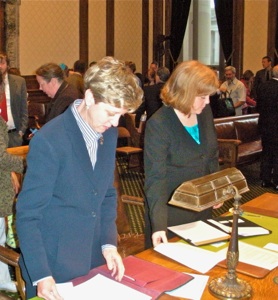
Kristen Boyles and Janette Brimmer of Earthjustice, preparing for oral argument before the Justices of the Washington State Supreme Court - June 16, 2011.